Assessing Change Readiness: Techniques and Tools for Effective Team Evaluation to Improve Organizational Adaptability
By Ann Marvin, The AIM Methodology
The question worth asking before any change initiative is not "how adaptable is this team in general," but "is this organization ready for this specific change." Those are different questions with different answers. A team that absorbed a system rollout smoothly last year may still be unprepared for a restructuring this year, because readiness is not a fixed trait, it is a condition tied to the initiative in front of you. In this article, we examine change management readiness through that lens, distinguishing organizational capacity for additional change, historical implementation experience, sponsor readiness, individual readiness, and the risk profile of the specific initiative. We also walk through the assessments AIM uses to measure each of these dimensions, the difference between activity and genuine behavioral adoption, and what sponsors and leaders are responsible for once the data is in hand.
AIM's Core Readiness Assessments
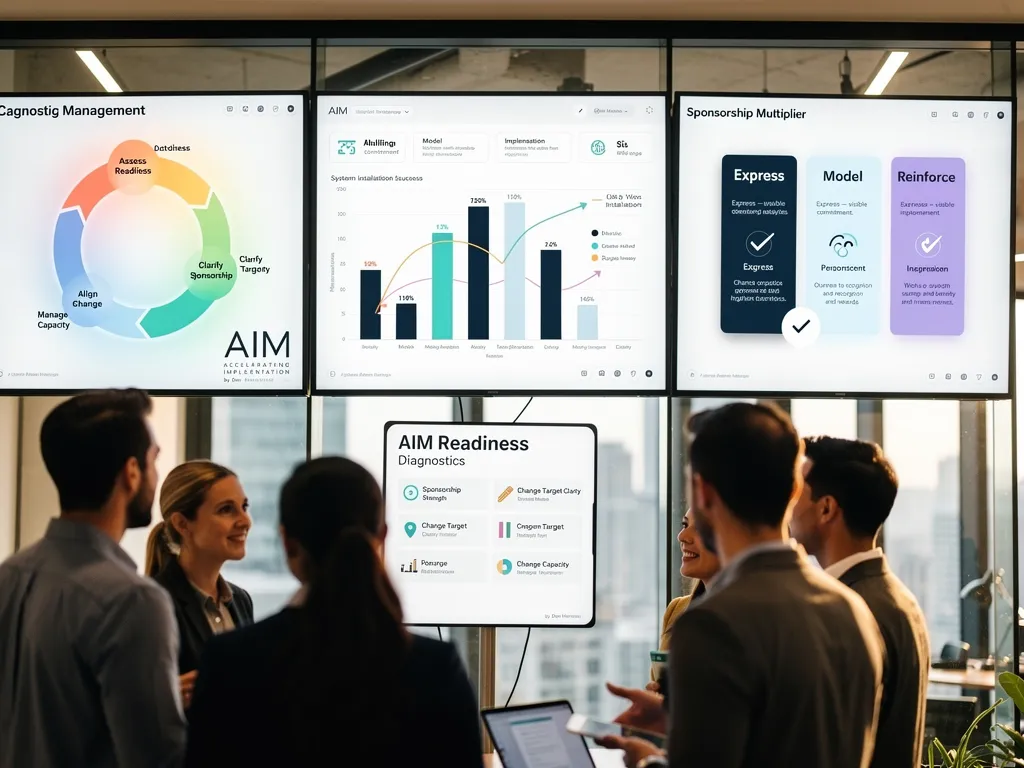
The Accelerating Implementation Methodology (AIM) organizes change management around ten practice areas, four of which are supported by scored diagnostic instruments hosted on Comparative Agility. Rather than relying on generic surveys, these diagnostics measure readiness against the specific practices AIM identifies as predictive of successful implementation, including sponsorship strength, clarity of the change target, and the organization's capacity to absorb additional change. AIM also draws a distinction between installation and implementation: installation is the decision to adopt a change and roll it out, while implementation is the sustained, correct, and consistent use of that change by the people expected to use it. Readiness assessment exists to close the gap between the two, identifying where an organization is likely to install a change without ever truly implementing it.
From Activity to Adoption: Reading Observable Behavior

Change readiness assessment depends on observable behavior rather than self-reported intention, but not every observable data point carries the same weight. Employee engagement scores, training attendance, and participation in feedback loops are activity and sentiment measures. They indicate that people are present and responsive, not that the new behavior has replaced the old one. AIM's distinction between installation and implementation applies directly here: high activity levels can reflect installation, the outward motions of compliance, without evidence of implementation, the sustained use of the new behavior in day-to-day work. Organizations that treat activity metrics as proof of readiness risk declaring success prematurely. A more rigorous assessment tracks whether the specific behaviors the change requires are actually being performed, by whom, and how consistently, rather than how many people attended a training session.
What Are the Key Change Readiness Assessment Tools for Teams?
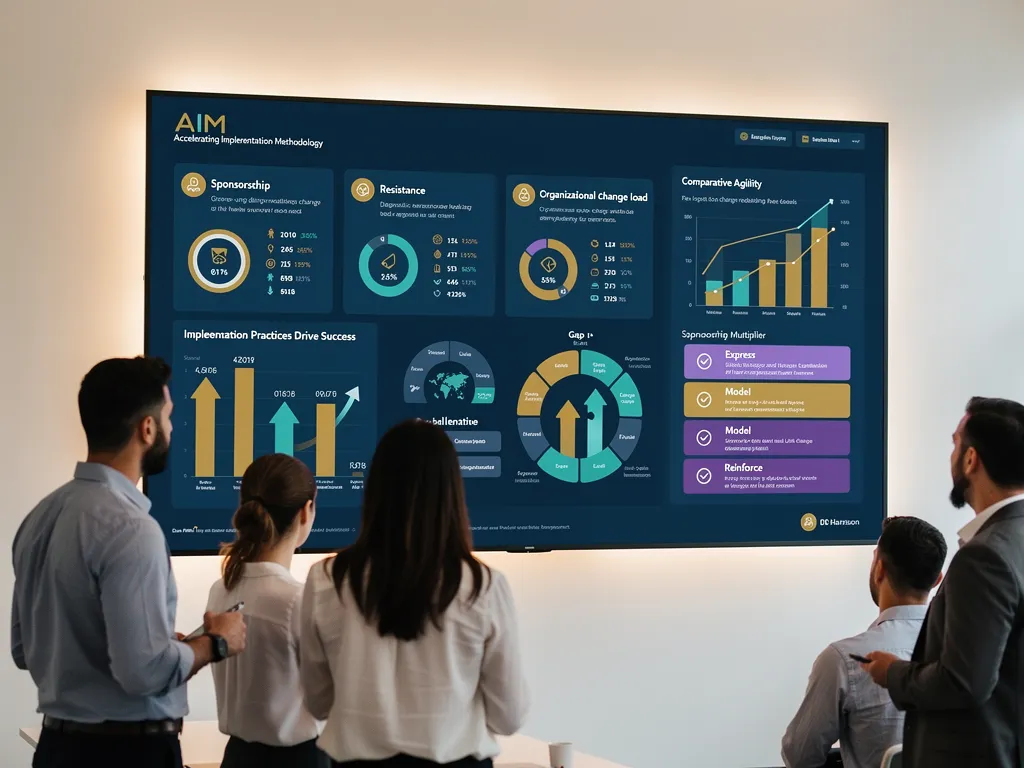
Grounded assessment starts with AIM's diagnostics rather than off-the-shelf survey templates. The core scored instruments evaluate sponsorship, resistance, organizational change load, and the practices most closely tied to implementation success, giving leaders a specific and comparable picture of readiness rather than a general adaptability score. Because four of these diagnostics are benchmarked through Comparative Agility, organizations can also see how their scores compare against a broader dataset of past implementations, sharpening the read on where a given initiative is most exposed.
Independent research supports the value of structured, purpose-built instruments over generic readiness surveys.
Organizational Readiness for Change: Assessment Tools Content Analysis Organizational readiness assessments have a history of being developed as important support tools for successful implementation. However, it remains unclear how best to operationalize readiness across varied projects or settings. We conducted a synthesis and content analysis of published readiness instruments to compare how investigators have operationalized the concept of organizational readiness for change. Unpacking organizational readiness for change: an updated systematic review and content analysis of assessments, IM Miake-Lye, 2020
How Do Change Readiness Surveys Measure Team Adaptability?
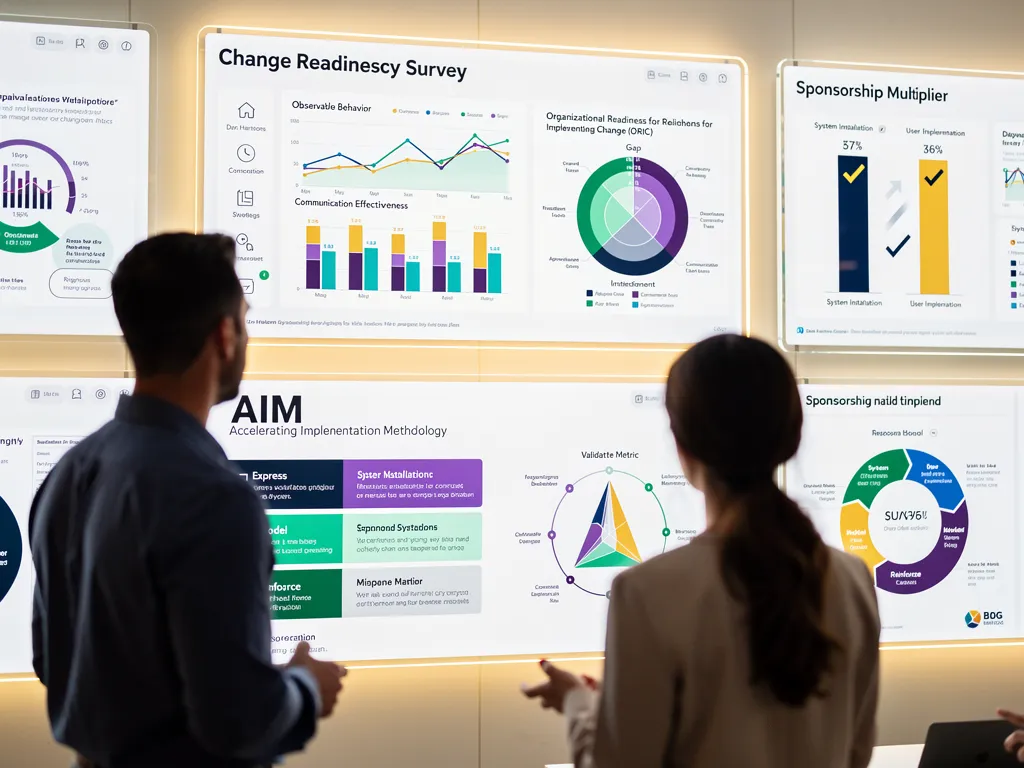
Well-constructed readiness surveys focus on the same ground as AIM's diagnostics: observable behavior, communication effectiveness, and the strength of support systems around the specific change, not general team sentiment. The development of validated measures such as the Organizational Readiness for Implementing Change (ORIC) scale reflects the same underlying problem AIM's diagnostics are built to solve: readiness needs a reliable, evidence-based measure rather than an impression.
Psychometric Assessment of Organizational Readiness for Change (ORIC) Organizational readiness for change in healthcare settings is an important factor in successful implementation of new policies, programs, and practices. However, research on the topic is hindered by the absence of a brief, reliable, and valid measure. Until such a measure is developed, we cannot advance scientific knowledge about readiness or provide evidence-based guidance to organizational leaders about how to increase readiness. This article presents results of a psychometric assessment of a new measure called Organizational Readiness for Implementing Change (ORIC), which we developed based on Weiner's theory of organizational readiness for change. Organizational readiness for implementing change: a psychometric assessment of a new measure, CM Shea, 2014
Sponsorship: Express, Model, Reinforce
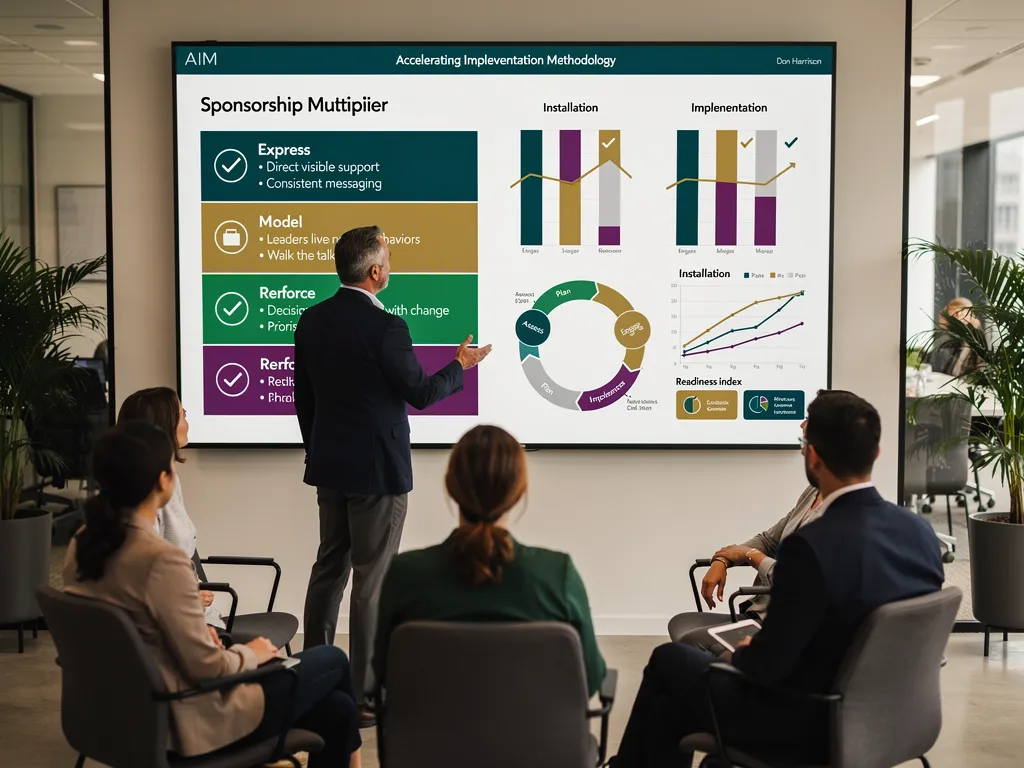
Sponsorship in AIM is not a matter of leaders participating in a change effort. It is a defined set of responsibilities. Sponsors are expected to express support for the change directly and consistently, model the new behaviors themselves rather than delegating that visibility to others, and reinforce the change through the decisions they make and the priorities they signal. This is among the six leadership tasks AIM identifies as non-delegable, meaning no amount of project management or communication planning from a change team can substitute for it. A readiness assessment that overlooks sponsor readiness is incomplete, because an organization can score well on individual and team readiness and still fail an initiative if the sponsor has not visibly expressed, modeled, and reinforced the change.
Resistance, Change Load, and Feedback

Resistance is not a signal to suppress. It is data. Active feedback, where teams are asked directly and specifically about the change, surfaces different information than passive feedback gathered incidentally, and organizations that rely only on the latter tend to miss resistance until it has hardened into disengagement. Change load compounds this risk: teams already absorbing multiple initiatives have less capacity for a new one, regardless of how well-designed that initiative is. Leaders addressing change fatigue need to first assess the organization's current change load honestly, then build targeted strategies around the specific sources of resistance the feedback data reveals, rather than applying a uniform communication plan to every team. Assessment that accounts for both a team's implementation history and its present change load produces a more accurate reading of readiness than behavioral observation alone.
Reinforcement: Aligning Consequences With the New Behavior

Reinforcement in AIM is not primarily about celebrating early adopters, though recognition has a role. It is about aligning organizational consequences, performance expectations, incentives, and management attention, with the behavior the change requires. If the formal and informal reward structures still favor the old way of working, the new behavior will not hold regardless of how much initial enthusiasm it generated. Sustained implementation depends on updating what gets measured, what gets rewarded, and what gets corrected, so that the reinforcement infrastructure and the desired behavior point in the same direction.
What Leaders Do With the Findings

A readiness assessment is only as useful as the decisions it drives. Leaders reviewing the results should be looking for where the organization is exposed: a sponsor who has not visibly modeled the change, a team whose change load leaves little capacity for another initiative, or activity metrics masking a lack of real behavioral adoption. Distinguishing organizational capacity, implementation history, sponsor readiness, individual readiness, and initiative-specific risk allows leaders to target interventions precisely, strengthening sponsorship where it is weak, addressing change load where it is high, and correcting reinforcement where it still favors old behavior, rather than applying a single generic readiness score to a problem that is rarely generic.